So you’ve seen “AI training jobs” pop up somewhere and you’re wondering if it’s actually a thing. It is. Every major AI lab needs human feedback to make their models better, and right now they’re paying real people real money for it. Not a gimmick, not an “influencer told me about it” scheme — an actual, growing corner of the job market that most people haven’t caught onto yet.
If you can write clearly, think critically, or bring any kind of professional background to the table, there’s a spot for you here. Let me walk you through it.
Quick answer: you get paid to evaluate, correct, or label AI outputs — rating responses, writing sample answers, catching errors. General platforms run $15-35/hr. Specialist platforms (the ones that want a real professional background) run $60-200/hr and up. Most want you to pass an assessment first — sometimes a written test, sometimes a genuine AI-conducted interview. You get paid through Stripe, Payoneer, Deel, or Tipalti depending on the platform. And every single one of these is free to try.
Table of Contents
Want Weekly AI Job Drops?
Get verified, high-paying remote AI opportunities sent straight to your inbox.
What You Do in AI Training Jobs
Cut through the jargon and it’s really just a handful of things:
Data annotation is labeling images, text, or audio so a model can learn from it. Model evaluation is reading an AI’s answer and rating how good it actually is. RLHF — Reinforcement Learning from Human Feedback, if you want the full term — is comparing two AI answers and picking the winner, or writing the ideal answer yourself. Red teaming is trying to break the model on purpose so the devs know what to fix.
Most platforms turn this into one simple loop: you get a task, work against a rubric, get reviewed, and get paid. Do a few and it just clicks.
Why Everyone’s Suddenly Talking About AI Training Jobs
AI labs are racing each other, hard. And one thing they still need at scale is human judgment. A model can guess whether a legal explanation holds up — it still needs someone who actually knows law to confirm it. That’s why pay has climbed so fast for people with real expertise. Medicine, law, code, finance, whatever your thing is. Mercor’s own CEO has said the company pays out over $1.5 million a day to the people training AI on its platform — this isn’t a side hustle blog exaggerating, that’s real money moving through this space daily.
Don’t have a specialist background? You’ve still got a wide lane of general annotation work open to you, as long as you can pass the entry assessment.. Honestly, that’s the fun part of this space right now — a backend dev, a nurse, a lawyer, and a sharp generalist can all land a real paycheck in the same industry, just at different pay tiers.
What It Takes to Land AI Training Jobs
Don’t let “requirements” scare you off. None of this is unreasonable, and it costs nothing to try.
You’ll need solid English — expect a written assessment somewhere in the process, just write like yourself. There’s almost always a qualifying task or exam, and this is the part that actually matters, so give it your full attention the first time around. ID verification is standard too — a one-time thing, keeps your payments secure. Worth checking whether your country is eligible before you apply — takes two minutes, saves you a headache later. And if you’ve got real credentials (a degree, license, serious hands-on experience), that’s your key to the top-tier platforms and the top-tier pay.
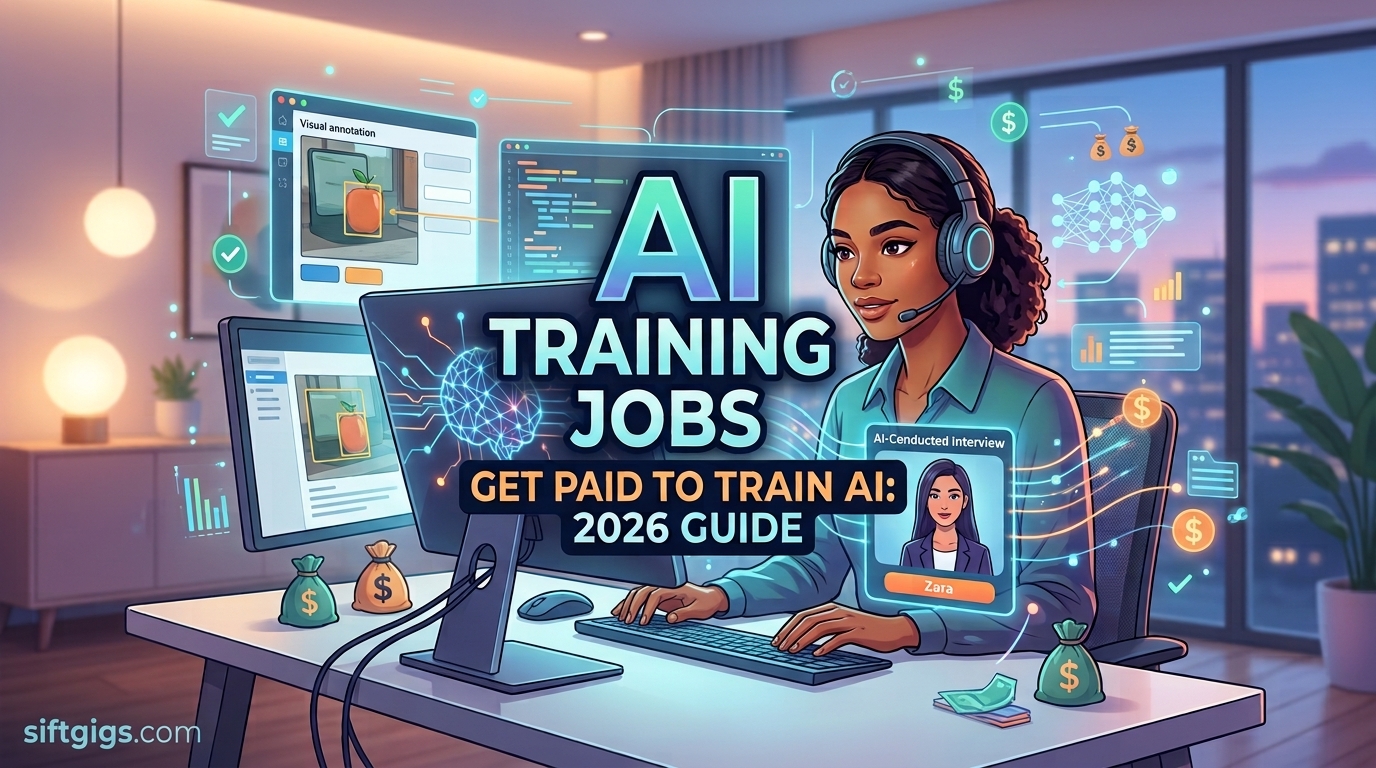
Heads up — some of these actually interview you with AI. This surprises people the first time, so let’s talk about it straight. Mercor runs an AI-conducted video interview as part of its process, asking questions tied to your claimed background — it’s genuinely where a lot of applicants drop off, so treat it like a real interview, not a formality. Micro1 takes it even further with an AI interviewer named Zara (also licensed out to a few other platforms, including Alignerr): a split-screen session where you code or answer technical questions live while she follows up adaptively, while a second AI system called Ava scores your focus and integrity in the background — you need to clear a 70% integrity score or you’re auto-failed regardless of how well you answered. Sounds intense, but it’s just a different flavor of vetting — show up prepared, narrate your thinking out loud, don’t switch tabs or glance at a second screen, and treat it exactly like a real technical interview, because it is one.
One safety note worth taking seriously: no legitimate platform in this space will ever ask you for your banking password or a payment to “unlock” work during the application. If that happens, you’re not looking at a real platform — walk away.
If you’re brand new to this, start with a general platform. Get a feel for it. Then branch into whatever specialist lane fits your background — that’s genuinely where the money is.
How Pay Works in AI Training Jobs
No single system runs the whole space — every platform rides its own payment rail, and that’s worth knowing before you apply, not after. Mercor currently pays weekly, with payments processed on Wednesdays, through Stripe where supported (funds land in a Stripe Express account, then hit your bank in a couple of days, or as fast as 30 minutes with Instant Payouts) or through Wise in countries Stripe doesn’t cover — though your very first payout is held for 7 days. Mindrift, owned by Toloka, absorbed Toloka’s older classic contributor platform in a July 2026 merger — same account, same payments, just one platform now. It pays twice a month on the 5th and 20th through Payoneer, with no minimum threshold, so whatever you earned that cycle actually shows up. Outlier runs on a Hyperwallet-powered system, weekly. Alignerr pays through Deel. Others lean on straight bank transfer or PayPal.
Translation: pick a platform whose payment rail actually reaches your country before you sink hours into an application. It’s a five-minute check that saves you from passing every assessment and never seeing a dollar.
On the pay itself — hourly rates run $15-35/hr on general platforms, sometimes climbing past $100/hr for specialist work. Per-task and per-accepted-contribution pay is common too, and it’s worth knowing this can look smaller in practice than the headline number suggests — some platforms advertise “$15-100/hr” while the bulk of entry-level task work actually pays a few dollars across an active hour, with the higher numbers reserved for specialist-tier projects once you’ve built a track record. That’s not a red flag, it’s just how tiered platforms work — the top of the range is real, you just have to earn your way into it.
Top Platforms for AI Training Jobs
There’s no single “best” one here — they hit differently depending on your background and how deep you want to go. Full breakdowns on each are coming to SiftGigs, covering exactly how to get in and what to expect.
Mercor — vetted contributor marketplace connecting you straight with AI labs like OpenAI and Anthropic. AI video interview plus a skills assessment. Pays weekly via Stripe (or Wise where Stripe isn’t supported). Reported rates span a wide range depending on domain — from around $10/hr for general contributor work up to $150-$220/hr for specialists in fields like management consulting and data science.
Mindrift — owned by Toloka, one of the largest pools in this space (20,000+ trainers across 90+ domains). Standard application, no AI interview. Twice-monthly Payoneer payouts, with per-task entry-level work often paying just a few dollars an hour in practice, against a genuine $50-200/hr tier once you clear vetting into specialist work.
Meridial Marketplace (by Invisible) — project-based AI training work, time tracked through Hubstaff.
Outlier AI — accessible general annotation and evaluation, backed by Surge AI, weekly Hyperwallet payouts.
Micro1 — AI-driven vetting through its Zara interviewer, now spanning a talent marketplace, standalone AI recruiting tools, and data annotation work. Engineering rates run from roughly $38/hr average up to $70-120/hr for specialized ML roles.
TELUS International AI Community — huge scale, steady task flow (used to be Lionbridge AI).
Pasiflora AI — expert-tier, built for credentialed specialists (MDs, JDs, PhDs), backed by NVIDIA’s Inception program.
Alignerr — Labelbox’s platform, focused on cognitive labeling and AI alignment work, paid through Deel.
OneForma — annotation, transcription, and translation work.
Apply to more than one, honestly. They’re free, task flow shifts around week to week, and the people doing well here are usually working two or three platforms at once, not just sitting on one waitlist.
Want Weekly AI Job Drops?
Get verified, high-paying remote AI opportunities sent straight to your inbox.
A Few Things That’ll Save You Time
Apply to a few platforms, not just one — more doors open, steadier work. Take the qualifying assessment (or AI interview, if the platform runs one) seriously the first time; it’s the gate that actually matters. Check your country’s eligible, and confirm the platform’s payout method actually reaches you, before you sink time into an application. And go in with real numbers in your head, not hype — you’ll enjoy the work more and actually stick with it.
FAQ
Do I need a degree to get an AI training job?
Nope, not for the general platforms — open to anyone who passes the assessment. The expert-tier ones like Pasiflora AI do want real credentials, since they’re paying specialist rates for specialist knowledge.
Is this reliable long-term income?
It can be, but don’t treat any single platform like a guaranteed paycheck. Task availability fluctuates, projects end, and platforms change their requirements. The safer approach is to stay active on multiple platforms at once — that’s what the people doing well here actually do.
How competitive is it?
General platforms are very winnable if you actually take the assessment seriously. Specialist platforms are more selective — they’re paying specialist money, after all — but if your background fits, you’re exactly who they want.
Do platforms really interview you with AI?
Yes, some do — Mercor and Micro1 both run AI-conducted interviews as part of vetting. It’s a real, live assessment, not a gimmick. Treat it exactly like you’d treat a human interview.
Do I need special software or equipment?
Just a decent computer and stable internet, most of the time. Anything specific gets listed right at signup — a few platforms do require tracking software like Hubstaff or Insightful while you work.
Is this taxable income?
Yes. Treat it like contractor income, keep your records straight, and check your local rules.
Bottom Line
This is real, it’s growing, and right now’s a genuinely good time to jump in. It’s not instant, and it’s not effortless — take the assessments (and interviews) seriously, check that your payout method actually works in your country, spread yourself across a couple of platforms — but people putting in real effort here are building solid, flexible income. Go apply. It costs you nothing but a bit of time, and there’s a real seat at this table.
This guide draws on firsthand experience working with several of the platforms above, along with publicly available platform documentation and current payout information. Details can change quickly in this space (Mindrift’s Toloka merger being a good example), so always double-check specifics directly with each platform before applying.
Want Weekly AI Job Drops?
Get verified, high-paying remote AI opportunities sent straight to your inbox.